.png)
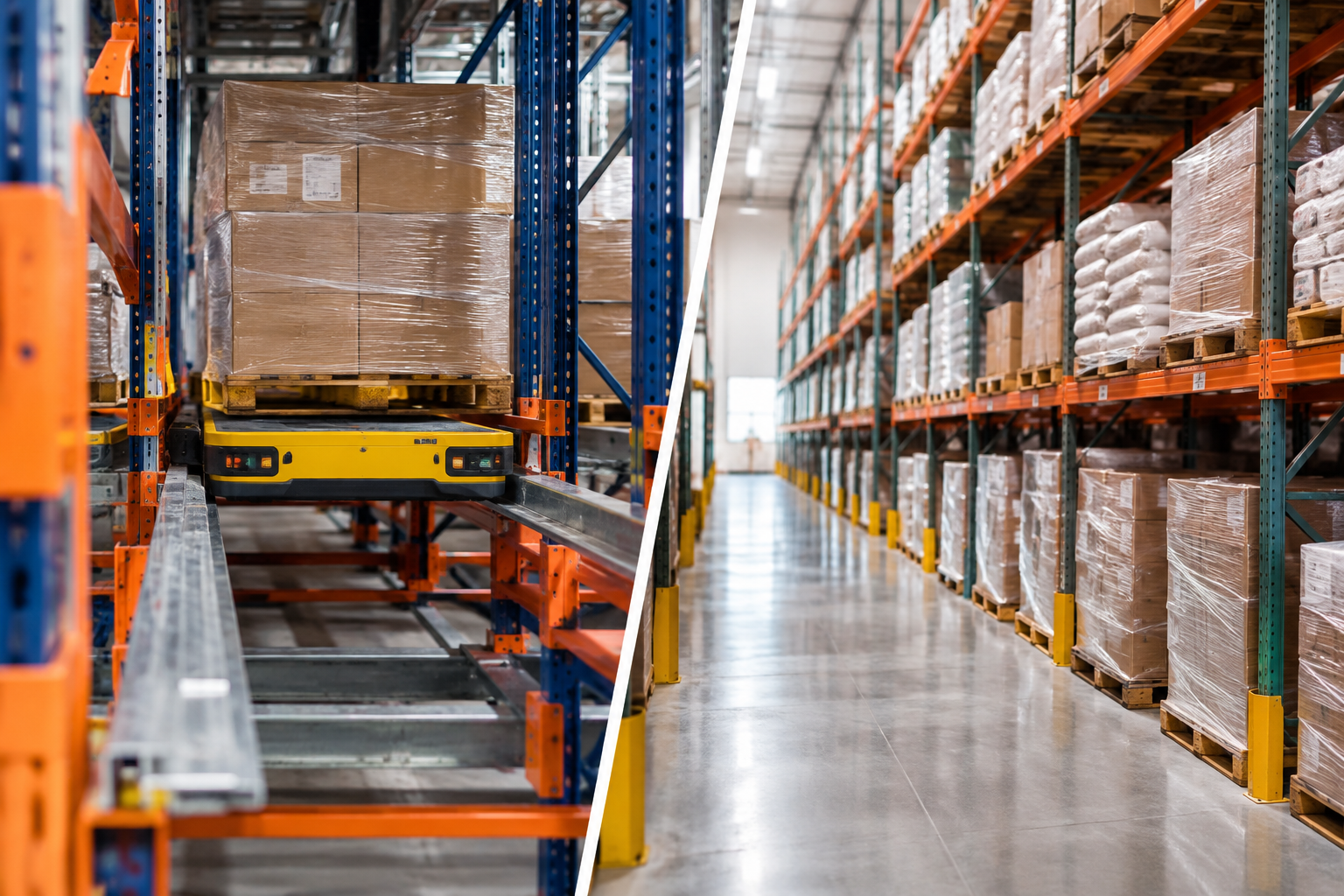
The pallet racking market, valued at $14.55 billion in 2026 and projected to reach $22.21 billion by 2030 at an 11.1% CAGR, is not growing because warehouses suddenly have more floor space. It is growing because they have less of it, and the pressure to do more with every square foot has never been higher. Pallet shuttle systems are at the center of that conversation. Every trade publication, every automation vendor, and every logistics conference is talking about them. And if you have been shopping for a storage solution recently, you have probably heard a pitch that made shuttle systems sound like the obvious answer to every problem you have.
Here is the thing: they are not. Neither is traditional selective racking. The right answer depends entirely on your operation, and the only way to get an honest comparison is to talk to someone who installs both and has no financial reason to push you toward one over the other. That is exactly the position Atlantic Rack has been in since 2001, serving operations across Florida and beyond for clients ranging from Coca-Cola to NASA. So here is the real breakdown.
What Pallet Shuttle Systems Actually Do
A pallet shuttle system uses a battery-powered robotic cart that travels along rails inside deep storage lanes. A forklift places the shuttle and a pallet at the lane entrance, and the cart takes it from there, moving the pallet deep into the lane without the forklift ever entering the rack structure. Modern systems are IoT-connected, meaning operators can monitor shuttle position, battery status, and inventory data in real time from a tablet or WMS interface.
The density gains are real. In a documented case study comparing storage systems for a motor oil distributor, a pallet shuttle configuration in the same footprint yielded 1,560 pallet positions versus 864 positions with selective rack, an 80% increase. That is not a marketing number. That is geometry.
Shuttle systems also support both FIFO and LIFO inventory flow, which gives them an operational flexibility that drive-in racking simply cannot match. And because forklifts never enter the lanes, rack damage from forklift collisions drops dramatically, which reduces long-term maintenance costs.
What Traditional Racking Still Does Better
Selective pallet rack remains the most widely used storage system in the world for good reason. Every pallet position is directly accessible. You can store hundreds of different SKUs without any lane management discipline. You can reconfigure the system as your inventory mix changes. And the upfront cost per pallet position is significantly lower than any automated alternative.
For operations with high SKU diversity, frequent order picking across many product lines, or inventory that turns over quickly and unpredictably, selective rack gives you something shuttle systems cannot: total flexibility. A shuttle system requires lane discipline. Each lane is typically dedicated to one SKU per level. If your inventory profile does not support that kind of organization, you will end up with partially filled lanes and wasted capacity, which defeats the entire purpose of the investment.
Push-back rack and pallet flow rack sit in the middle of this spectrum, offering density improvements over selective rack without the technology overhead of a shuttle system. They are worth considering when your SKU count is moderate and your budget does not support full automation.
The SKU Count Question Nobody Asks You First
The single most important variable in this decision is not your square footage. It is your SKU count relative to your pallet depth per SKU.
Shuttle systems perform at their best when you have a low-to-medium number of SKUs with many pallets of each. If you are storing 20 SKUs with 30 pallets per SKU, a shuttle system will fill those lanes efficiently and deliver the density and speed gains the brochures promise. If you are storing 200 SKUs with 3 pallets each, you will spend more time managing lane assignments than you will save in forklift travel.
The general industry guidance is consistent on this point: pallet shuttles are optimized for low-to-medium SKU environments with deep lane requirements. That profile fits cold storage, food and beverage distribution, beverage manufacturing, and bulk consumer goods well. It fits a general merchandise 3PL or a parts distribution center much less cleanly.
The Real Cost Comparison
Shuttle systems cost more upfront. That is not a reason to avoid them, but it is a number you need to model honestly before committing.
The automated pallet shuttle market was valued at $3.8 billion in 2025 and is growing at a 9.5% CAGR, which tells you that operations are finding the ROI. But the ROI calculation has to include more than just pallet positions per square foot. It needs to account for forklift labor hours saved, rack repair costs avoided, throughput speed improvements, and the cost of the WMS or control software required to run the system effectively.
One finding that surprises most buyers: in certain configurations, the total installed cost of a pallet shuttle system can be comparable to or only modestly higher than a pallet flow rack system. The shuttle hardware is concentrated in the cart itself rather than distributed across thousands of feet of gravity rails and wheels, which changes the material cost equation in ways that are not obvious from a spec sheet.
Selective rack, by contrast, has a low upfront cost but a hidden cost in the form of square footage. If your facility is in South Florida, where industrial lease rates have climbed sharply over the past several years, the cost of the extra floor space consumed by selective rack aisles is a real number that belongs in your comparison.
Cold Storage and Freezer Applications
This is where shuttle systems have the clearest advantage over every alternative. In a freezer environment, every square foot of refrigerated space costs significantly more to build and operate than ambient space. Maximizing density is not just an efficiency goal, it is a direct operating cost reduction. Shuttle systems eliminate the need for forklifts to idle inside cold lanes, which reduces energy loss from open doors and improves worker safety. Lithium battery shuttles perform reliably in freezing temperatures where older lead-acid systems struggled. If you operate cold storage in Florida, the ROI case for shuttle systems is among the strongest in any application.
When to Combine Both Systems
The most practical answer for many mid-size operations is not a choice between shuttle and selective rack. It is a hybrid layout that uses each system where it performs best.
High-volume, low-SKU products go into shuttle lanes. Fast-moving, high-SKU products stay in selective rack with direct access. Bulk reserve storage uses the density of the shuttle system while active pick faces remain in a conventional selective or flow configuration. This kind of layout requires careful slotting analysis and a design team that understands both systems, but it consistently delivers better overall throughput and space utilization than either system alone.
What This Means for Your Operation
The growth of the pallet shuttle market reflects a real shift in what warehouses need. Density, speed, and connectivity are not optional features anymore. But the technology does not replace the analysis. A shuttle system installed in the wrong operation will underperform a well-designed selective rack layout every time.
Atlantic Rack has been designing and installing both traditional and automated racking systems across Florida since 2001. We sell over 115,000 material handling products and have no incentive to push you toward a system that does not fit your operation. If you want an honest assessment of whether a pallet shuttle system, a traditional racking configuration, or a hybrid layout makes sense for your facility, contact our team for a no-obligation consultation. We will run the numbers with you, not for you.
Sources
- Research and Markets: Pallet Racking Market Report 2026
- DataIntelo: Automated Pallet Shuttle Market Research Report 2034
- REB Storage Systems: Selective Rack vs Pallet Flow Rack vs Pallet Shuttle Case Study
- Addverb: Pallet Shuttle vs Carton Shuttle AS/RS Comparison
- OKE Storage: Drive-In Racking vs Pallet Shuttle Racking
- Interlake Mecalux: 4-Way Shuttle High-Tech Pallet Storage