.png)
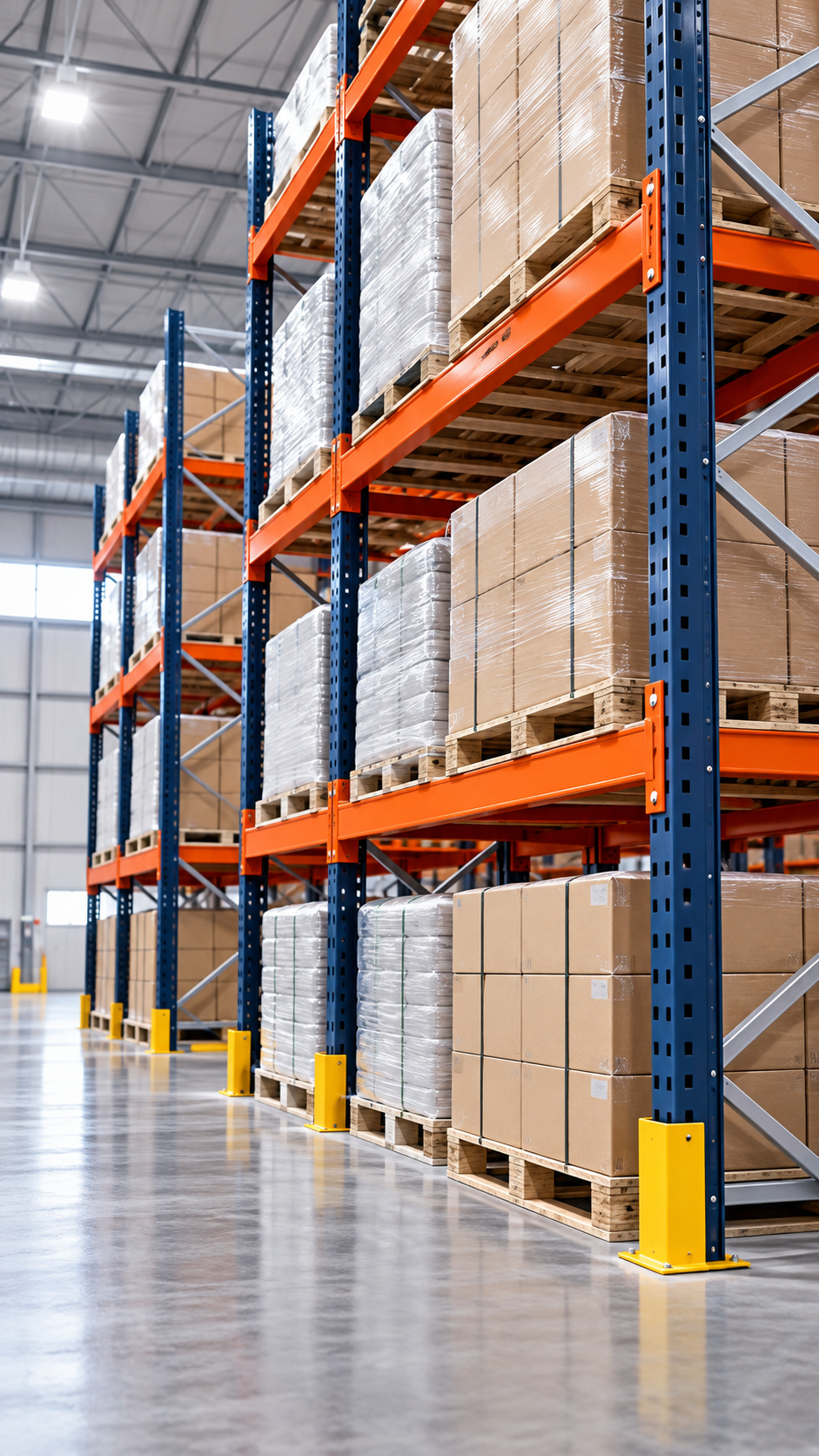
Pallet Rack Load Capacity: How Much Weight Can Your Racking Hold?
Understanding pallet rack load capacity is essential for maintaining a safe and efficient warehouse. Pallet racking is designed to support heavy loads, but the amount of weight a system can safely hold depends on much more than the strength of a single beam.
Beam size, upright capacity, rack height, beam spacing, pallet weight, load distribution, and the overall rack configuration all affect how much weight a pallet rack system can support.
Knowing these factors can help prevent overloading, rack damage, product loss, and unsafe warehouse conditions.
What Is Pallet Rack Load Capacity?
Pallet rack load capacity refers to the maximum amount of weight a rack system can safely support under its designed configuration.
There are several different capacity ratings that need to be considered.
These include:
- Beam capacity
- Upright or frame capacity
- Pallet weight
- Bay capacity
- Overall rack configuration
A rack system should always be evaluated as a complete structure rather than looking at one component by itself.
1. Beam Capacity
The horizontal beams are the components that directly support the pallets.
Each pair of beams has a specific load capacity based on factors such as:
- Beam length
- Beam height
- Beam profile
- Steel thickness
- Connection type
In general, longer beams may support less weight than shorter beams of the same design.
For example, a beam pair rated for 5,000 pounds means the total evenly distributed weight placed across those beams should not exceed 5,000 pounds.
If two pallets are stored on that level, the combined pallet weight must remain within the rated beam capacity.
2. Upright Frame Capacity
The upright frames support the vertical load of the entire rack system.
Their capacity depends on several factors, including:
- Upright column size
- Steel thickness
- Frame depth
- Beam spacing
- Rack height
- Number of storage levels
- Bracing design
One important factor is the distance between beam levels.
As vertical spacing increases, the capacity of the upright frame can decrease.
This is why changing beam elevations or adding storage levels should never be done without confirming that the rack system can safely support the new configuration.
3. Load Distribution Matters
Pallet rack capacity ratings usually assume that weight is distributed evenly across the beams.
An uneven load can place excessive stress on one section of the rack.
For example, a pallet with most of its weight concentrated on one side may create more stress than an evenly loaded pallet of the same total weight.
Loads should be properly positioned and centered whenever possible.
4. Pallet Weight Must Be Known
One of the simplest ways to reduce the risk of overloading is to know the weight of the pallets being stored.
Warehouse operators should understand the approximate maximum pallet weight for each product or storage area.
If pallet weights vary significantly, the rack system should be designed around the heaviest expected loads.
This provides a safer operating margin and helps prevent accidental overloading.
5. Beam Spacing Can Change Rack Capacity
Vertical beam spacing has a major effect on upright capacity.
When beams are positioned closer together, the upright columns receive additional support.
When the distance between beam levels increases, the upright columns have a longer unsupported section.
This can reduce the amount of weight the frame can safely support.
Because of this, moving beams higher or lower can change the capacity of the entire rack system.
6. Rack Height Also Matters
Taller pallet rack systems experience greater forces than shorter systems.
As rack height increases, factors such as stability, anchoring, column strength, and building conditions become increasingly important.
High-bay storage systems should be carefully designed based on the building, product loads, and material handling equipment being used.
7. Floor Anchoring Is Part of the System
Pallet racks are typically anchored into the warehouse floor.
Proper anchoring helps stabilize the system and allows it to perform as designed.
The number, type, and installation of anchors may depend on the rack configuration and engineering requirements.
Damaged, loose, or missing anchors should be addressed quickly.
8. Rack Damage Can Reduce Capacity
Even if a rack was originally designed for a certain load, damage can reduce its ability to safely support that weight.
Common types of damage include:
- Bent upright columns
- Damaged bracing
- Twisted beams
- Broken beam connectors
- Missing safety clips
- Loose anchors
- Forklift impact damage
Warehouse teams should regularly inspect pallet racking and address damage before continuing to load affected areas.
9. Do Not Assume All Racking Has the Same Capacity
Two pallet rack systems that look similar may have completely different load capacities.
Small differences in beam design, upright dimensions, steel thickness, and rack configuration can significantly affect capacity.
For this reason, rack capacity should never be estimated based only on appearance.
Manufacturer specifications, engineering data, and the actual system configuration should be used whenever possible.
Load Capacity Plates and Signage
Warehouse operators should clearly communicate rack load limits.
Rack capacity signs can display information such as:
- Maximum pallet weight
- Maximum beam level capacity
- Maximum bay capacity
- Approved rack configuration
Clear signage helps forklift operators and warehouse employees understand the limits of the system.
It also reduces the chance of accidental overloading.
What Happens If Pallet Racking Is Overloaded?
Overloading pallet racking can place excessive stress on beams, uprights, connectors, and anchors.
Warning signs may include:
- Visible beam deflection
- Bent uprights
- Loose connections
- Rack movement
- Damaged anchors
- Leaning frames
In serious cases, overloading can contribute to rack failure and product collapse.
If there is any uncertainty about the condition or capacity of a rack system, the affected area should be evaluated before additional material is stored.
Can You Increase Pallet Rack Capacity?
In some situations, warehouse storage capacity can be increased through redesign.
Possible solutions may include:
- Changing beam sizes
- Adding additional storage levels
- Reducing beam spacing
- Using stronger upright frames
- Reconfiguring rack layouts
- Improving vertical space utilization
- Installing higher-density storage systems
However, changes should be evaluated carefully because modifying one part of a rack system can affect the capacity of the entire structure.
Pallet Rack Capacity Is More Than One Number
The safe capacity of a pallet rack system depends on the relationship between multiple components.
Beam capacity, upright capacity, pallet weight, beam spacing, rack height, anchoring, and load distribution all work together.
Understanding these factors can help your warehouse operate more safely while making better use of available storage space.
If you are unsure about your current pallet rack capacity or are planning a new warehouse storage system, having the rack configuration properly evaluated can help prevent costly mistakes.
Contact us and see how we can help you optimize your warehouse.
Atlantic Rack
📞 (305) 887-5777
📧 info@atlanticrackusa.com
🌐 www.atlanticrack.com