.png)
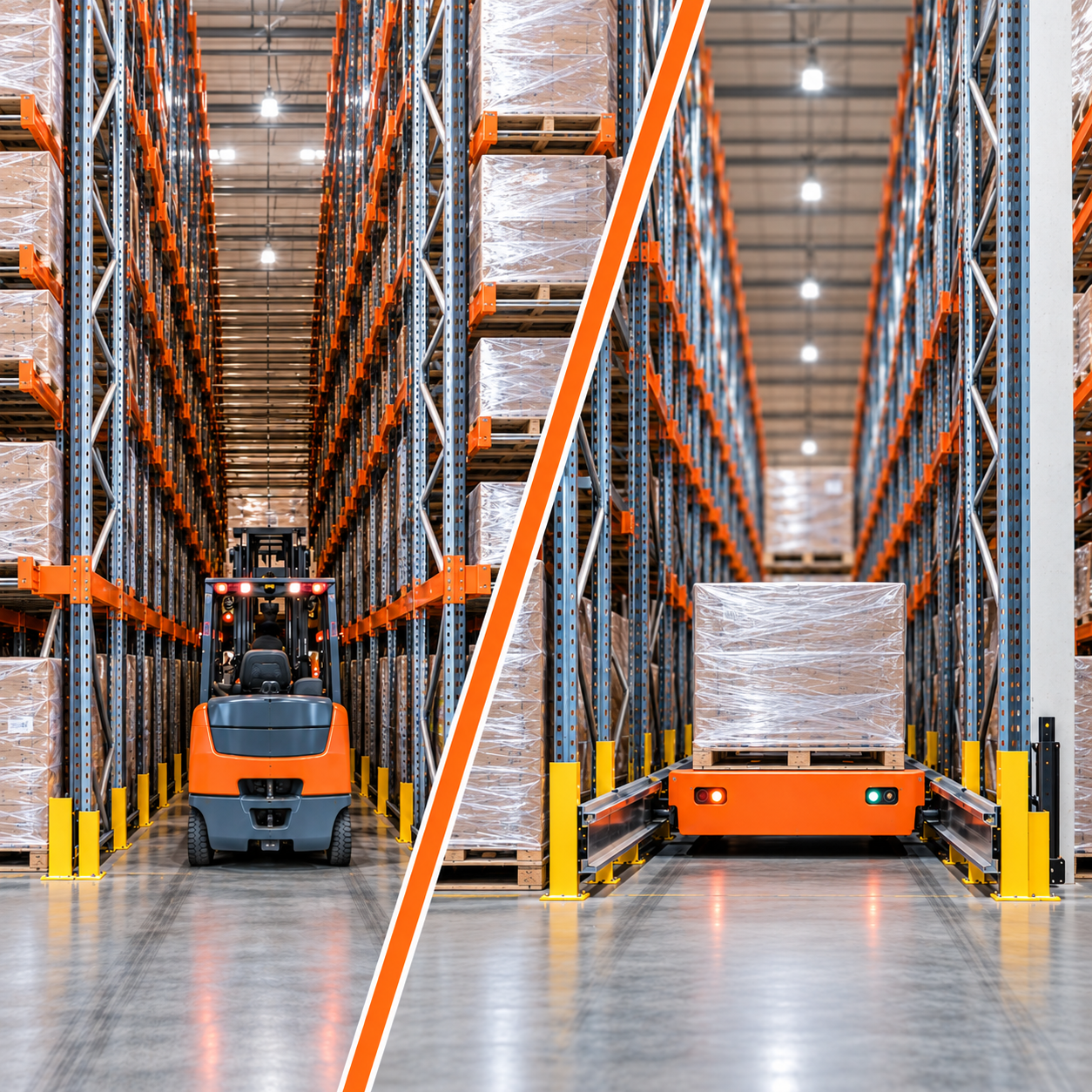
When warehouse space becomes limited, high-density storage can allow a company to increase pallet capacity without expanding its building.
Two common options are drive-in pallet racking and pallet shuttle systems.
Both systems reduce the number of aisles required and store pallets multiple positions deep. However, the way pallets move through the system is very different.
With drive-in racking, the forklift enters the rack structure to place and retrieve pallets. With a pallet shuttle system, the forklift remains at the front of the lane while a motorized shuttle moves pallets deeper into the rack.
That difference can have a major impact on throughput, forklift travel, rack damage, inventory rotation, operating costs, and the initial investment.
So which one makes more sense for your warehouse?
What Is Drive-In Pallet Racking?
Drive-in racking is a high-density storage system that allows forklifts to enter directly into the storage lanes.
Instead of having an aisle in front of every row of pallet rack, multiple pallets can be stored several positions deep.
This makes drive-in racking especially useful for warehouses that store large quantities of the same or similar SKUs.
Because the forklift operates inside the rack, the system is relatively simple and does not require powered shuttle equipment.
Drive-In Racking Can Be a Good Choice When:
- You need high-density pallet storage.
- You have a limited number of SKUs.
- You store many pallets of the same product.
- Pallet turnover is relatively low or moderate.
- LIFO inventory rotation works for your operation.
- You want a lower initial investment.
- You prefer a simple storage system with fewer powered components.
One of the biggest advantages of drive-in racking is its simplicity.
For the right application, it can provide a large increase in storage capacity without adding automation.
However, there is an important tradeoff: the forklift must travel inside the rack structure.
This means operators need to carefully navigate the storage lanes, and repeated forklift movement can increase the possibility of contact with the rack.
What Is a Pallet Shuttle System?
A pallet shuttle system uses a motorized shuttle to transport pallets inside deep storage lanes.
Instead of driving into the rack, the forklift places a pallet at the entrance of the lane. The shuttle then carries the pallet to the appropriate storage position.
When retrieving inventory, the process is reversed.
The shuttle brings the pallet back toward the front of the lane, where the forklift can remove it.
This allows warehouses to maintain high-density storage while significantly reducing the amount of forklift travel inside the racking system.
Drive-In Racking vs. Pallet Shuttle
Here is a simple comparison:
Factor Drive-In Racking Pallet Shuttle Storage Density High High Initial Investment Lower Higher Forklift Enters Rack Yes No Pallet Handling Speed Moderate Faster for high-volume operations Rack Contact Risk Higher because forklifts enter lanes Reduced because forklifts stay outside lanes Automation Manual Semi-automated or automated LIFO Capability Yes Yes FIFO Capability Possible with drive-through configurations Possible depending on system layout Maintenance Primarily rack and forklift related Rack plus shuttle equipment Best Application High-density storage with simpler operations High-density storage with higher throughput Neither system is automatically better.
The best choice depends on how your warehouse operates.
1. Storage Density
Both systems are designed to increase storage density by reducing the number of forklift aisles required.
This makes them useful when warehouse space is expensive or when a company is running out of pallet positions but wants to avoid relocating or expanding.
The biggest question is not simply:
“How many pallets can we fit?”
It is also:
“How efficiently can we move those pallets?”
That is where the systems begin to separate.
2. Throughput
Drive-in racking works well when inventory movement is predictable and pallet turnover is not extremely high.
As storage lanes become deeper, however, forklift operators need to travel farther into the rack to place and retrieve pallets.
Pallet shuttle systems change this process.
The forklift can place one pallet at the lane entrance while the shuttle handles movement inside the rack. This allows the forklift operator to move on to other tasks while the shuttle completes the storage cycle.
For high-volume distribution centers, food and beverage operations, manufacturing facilities, and cold storage environments, this increased efficiency can become an important advantage.
3. Forklift Travel and Rack Damage
One of the most important differences between the systems is forklift movement.
In drive-in racking, the forklift enters the storage lane.
Because operators repeatedly travel between rack uprights and pallet rails, accidental contact can occur over time.
With pallet shuttle systems, the forklift generally remains at the front of the lane.
The shuttle performs the deep-lane movement instead.
Reducing forklift travel inside the rack can help reduce rack contact while also making pallet movement easier for operators.
4. Inventory Rotation
Inventory rotation is another major consideration.
Traditional drive-in systems are commonly designed around LIFO — Last In, First Out.
The last pallet placed into the lane is typically the first one removed.
For many products, this works perfectly well.
Operations requiring FIFO — First In, First Out may use drive-through configurations or other storage systems designed around product rotation.
Pallet shuttle systems can also be configured for different inventory strategies depending on the system design and access points.
This can make shuttle systems useful for operations handling products with expiration dates or strict inventory rotation requirements.
5. Cost
Drive-in racking normally has the advantage when comparing initial equipment cost.
The system primarily consists of the rack structure and does not require powered shuttle equipment.
Pallet shuttle systems require a larger investment because they introduce motorized equipment, controls, batteries, and potentially warehouse software.
However, purchase price should not be the only consideration.
Companies should also evaluate:
- Labor requirements
- Forklift travel
- Pallet throughput
- Rack repairs
- Equipment maintenance
- Storage capacity
- Inventory accuracy
- Energy costs
- Future growth
A system with a higher initial cost can sometimes provide a better long-term return if it significantly improves the operation.
When Does Drive-In Racking Make More Sense?
Drive-in may be the better solution when your operation has:
High pallet quantities per SKU + moderate throughput + a limited automation budget.
It remains one of the simplest ways to create high-density pallet storage.
For warehouses that do not need faster automated pallet movement, adding shuttle technology may not be necessary.
When Does Pallet Shuttle Make More Sense?
Pallet shuttle systems become especially attractive when your operation has:
High storage density requirements + high pallet volume + frequent pallet movement.
They can also be valuable when reducing forklift travel, improving productivity, or preparing a warehouse for greater automation are important goals.
Industries that may benefit include:
- Food and beverage
- Cold storage
- Third-party logistics
- Manufacturing
- Retail distribution
- High-volume distribution centers
Don’t Choose a Storage System Based Only on Pallet Capacity
Two warehouses can have the same number of pallets and still require completely different storage systems.
Before choosing between drive-in racking and pallet shuttle automation, consider:
How many SKUs do you have?
How many pallets do you typically store per SKU?
How quickly does inventory move?
Do you require FIFO or LIFO rotation?
How many pallets move in and out each day?
How deep should each storage lane be?
How important is reducing forklift travel?
What level of automation makes sense for the operation?
What is your budget today — and what will the operation look like five years from now?
These questions matter more than simply comparing the price of the rack.
Finding the Right High-Density Storage Solution
Drive-in racking and pallet shuttle systems solve the same basic problem in different ways.
Drive-in racking provides high-density storage through a simple, cost-effective design.
Pallet shuttle systems combine high-density storage with automated pallet movement to improve throughput and reduce forklift travel inside the rack.
The right choice depends on your inventory, throughput, facility, equipment, budget, and future growth plans.
Atlantic Rack works with companies to evaluate their warehouse operations and design storage systems around how their inventory actually moves.
Whether the best solution is drive-in racking, pallet shuttle automation, push-back racking, pallet flow, selective rack, or a combination of systems, the goal is the same:
Maximize warehouse capacity while improving the efficiency of the operation.
Contact us and see how we can help you optimize your warehouse.