.png)
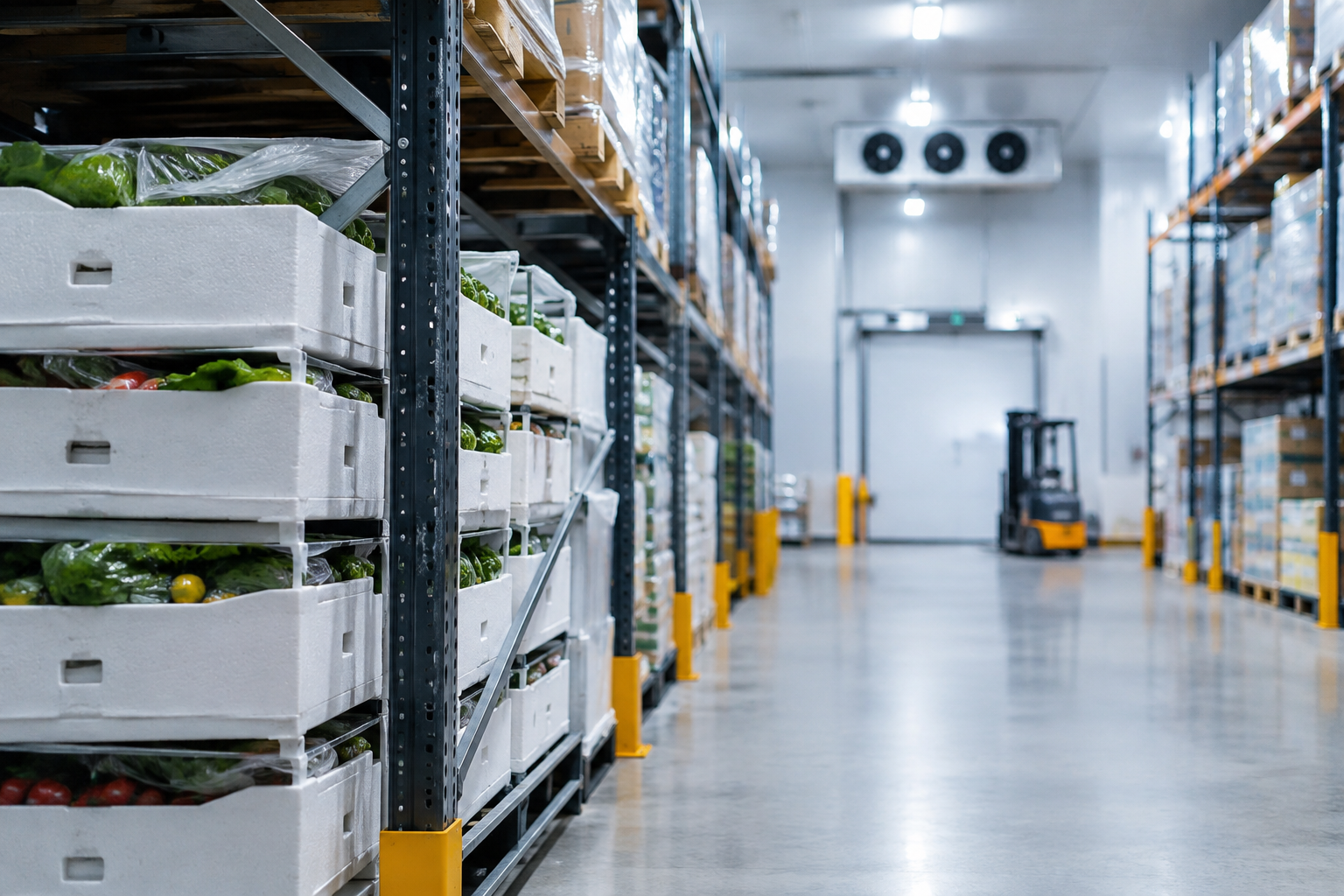
Florida’s cold storage operators are facing a math problem that doesn’t exist in ambient warehousing. When a frozen storage facility costs between $175 and $275 per square foot to build from the ground up — compared to $60 to $150 for a standard dry warehouse — every square foot of wasted vertical or horizontal space carries a price tag that compounds daily. Add to that the fact that national cold storage vacancy sits around 3.4%, significantly tighter than the 5 to 7% vacancy typical of conventional dry warehouse space, and the pressure to extract maximum capacity from every refrigerated cubic foot becomes the defining operational challenge of 2026.
Florida sits at the center of this pressure. Miami serves as one of the primary entry points for perishable imports from Latin America, with PortMiami handling daily links to Latin America and the Caribbean. Imports of vegetables from Central America alone grew 182% between 2019 and 2025. The region’s 6.2 million residents and 27 million annual tourists drive relentless demand for fresh and frozen goods, and Jacksonville continues to expand its refrigerated capacity to serve the rest of the state. Florida distribution operations are not competing for cold storage space in a theoretical market. They are competing for it right now, and the operators who win are the ones who treat their racking strategy as seriously as their refrigeration strategy.
Why Cold Storage Space Optimization Is a Different Problem
In a standard ambient warehouse, a poor racking layout costs you throughput and labor efficiency. In a cold storage facility, it also costs you energy. Cold storage facilities consume three to five times more energy per square foot than standard dry warehouses, with monthly energy costs running $0.50 to $1.25 per square foot. Every aisle you don’t need, every cubic foot of refrigerated air you’re cooling without product in it, is a direct operating cost that shows up on your utility bill every month.
The refrigerated envelope is fixed. The refrigeration system runs whether the building is at 40% capacity or 95% capacity. That means the economic logic of high-density storage in cold chain is fundamentally different from ambient warehousing: you are not just optimizing for space, you are optimizing for the ratio of stored product to refrigerated volume. Maximizing that ratio is how Florida cold chain operators reduce cost per pallet stored, improve energy efficiency, and protect throughput at the same time.
High-Density Racking Systems Built for Cold Chain Conditions
The racking systems that perform best in cold storage environments share a common characteristic: they reduce the number of aisles required to access product while maintaining or improving throughput rates. The three systems that Florida distribution operations are deploying most aggressively in 2026 are pallet shuttle systems, mobile racking, and drive-in or drive-through configurations.
Pallet shuttle systems are the most compelling option for high-volume frozen and refrigerated operations. A motorized shuttle cart travels within the racking lane, carrying pallets to and from the pick face without requiring a forklift to enter the lane. This eliminates the need for wide internal aisles, dramatically increasing storage density. Pallet shuttle systems can deliver up to 230% more storage capacity than traditional selective pallet racking, and they are specifically well-suited to cold storage because they reduce forklift traffic inside freezer zones, which lowers the heat load introduced by equipment and operators entering the refrigerated space. Fewer forklift entries mean less warm air infiltration at dock doors and less mechanical wear on the cold envelope.
Mobile racking systems take a different approach. The entire racking structure sits on motorized bases that move along floor tracks, eliminating all but one working aisle at any given time. The aisle opens where it is needed and closes when the operator moves to a different location. For refrigerated operations storing a wide SKU range, mobile racking can increase storage capacity by 80 to 100% compared to conventional selective racking in the same footprint. The tradeoff is throughput: mobile racking works best when pick frequency per lane is moderate rather than continuous. For Florida food distributors managing a broad product mix with defined pick windows, it is a highly effective solution.
Drive-in and drive-through racking remains a cost-effective high-density option for operations with a limited number of SKUs stored in deep lanes. Drive-in configurations support last-in, first-out (LIFO) inventory rotation, while drive-through supports first-in, first-out (FIFO) rotation from opposite ends of the lane. For frozen goods with longer shelf life, drive-in racking delivers strong density gains at a lower capital cost than shuttle systems. The limitation is selectivity: accessing a pallet in the middle of a deep lane requires moving product, which adds labor and reduces throughput if not managed carefully.
Vertical Space: The Most Underused Asset in Florida Cold Storage
Florida cold storage operators frequently underutilize clear height. A facility built with 40-foot clear height and racked to 20 feet is leaving half its refrigerated volume unproductive. The refrigeration system is cooling that upper air volume regardless. Stacker cranes and automated storage and retrieval systems (AS/RS) are increasingly viable for cold chain operations precisely because they operate effectively in extreme cold without requiring human workers in the storage zone.
The Global Cold Chain Alliance’s 2026 outlook confirms that robotics and AI-driven inventory management are accelerating across the industry, with leading operators deploying advanced systems specifically to optimize space utilization and energy efficiency. For Florida operations that are not yet ready for full AS/RS deployment, the intermediate step is maximizing racking height with very narrow aisle (VNA) configurations supported by man-up order pickers or turret trucks rated for cold storage environments. The capital investment is lower than full automation, and the density gains are substantial.
Throughput Is Not the Enemy of Density
The concern most Florida cold chain operators raise when evaluating high-density systems is throughput. The assumption is that denser storage means slower picking. In practice, the relationship between density and throughput depends almost entirely on system design and slotting strategy, not on the racking type itself.
Pallet shuttle systems, when properly integrated with a warehouse management system (WMS), can actually improve throughput compared to selective racking by reducing forklift travel distance and eliminating the congestion that occurs when multiple forklifts compete for aisle access in a conventional layout. The key is slotting: high-velocity SKUs belong at the front of shuttle lanes and at the most accessible positions in mobile racking configurations. Slow-moving product goes deep. When slotting is aligned with actual pick frequency data, high-density systems consistently outperform conventional selective racking on both storage efficiency and throughput metrics.
WMS integration is not optional in this context. A high-density cold storage system without real-time inventory visibility and lane management logic is a throughput problem waiting to happen. The WMS is what makes the density work operationally, directing shuttles, managing lane assignments, and ensuring that FIFO or LIFO rotation is maintained without manual intervention.
What Florida Operators Should Evaluate First
Before selecting a racking system, Florida cold chain operators need to answer four questions: What is the SKU count and how does velocity vary across the range? What is the required inventory rotation method — FIFO or LIFO? What is the existing clear height and floor load capacity? And what is the throughput requirement at peak, not average, demand?
The answers to these questions determine which high-density system fits the operation. A Miami produce importer with 50 SKUs and high daily throughput is a strong candidate for pallet shuttle. A Jacksonville food distributor with 500 SKUs and defined pick windows may be better served by mobile racking. A frozen goods operator with deep lanes and LIFO-compatible product may find drive-in racking delivers the best return on investment at the lowest capital cost.
Atlantic Rack has been solving exactly these problems for Florida distribution operations since 2001. With a catalog of more than 115,000 products and direct experience with cold chain clients across the state, the team can assess your current layout, model density and throughput scenarios across racking configurations, and specify a system that fits your operation rather than a generic solution pulled from a product sheet. If your refrigerated space is working harder than your racking system, that is the conversation to start. Contact Atlantic Rack to discuss your cold storage layout and find out how much capacity you are leaving on the table.
Sources:
- Global Cold Chain Alliance — Driving the Cold Chain: 2026 Outlook
- Terrapin Construction Group — Average Cost to Build a Cold Storage Facility in the USA (2026)
- OLIMP Warehousing — Gulf and Southeast US Cold Storage: Strategic Hubs, Facility Types and Costs
- High Density Pallet Shuttle System — Scribd
- Custom Market Insights — US Cold Storage Market Size, Trends, Share 2026–2035